The Importance of Leadership and Structure in the Military: A Reflection
Drones can sync without a commander. People can’t. Why the pyramid of command still decides who wins, and why an officer’s aura matters more than we admit.
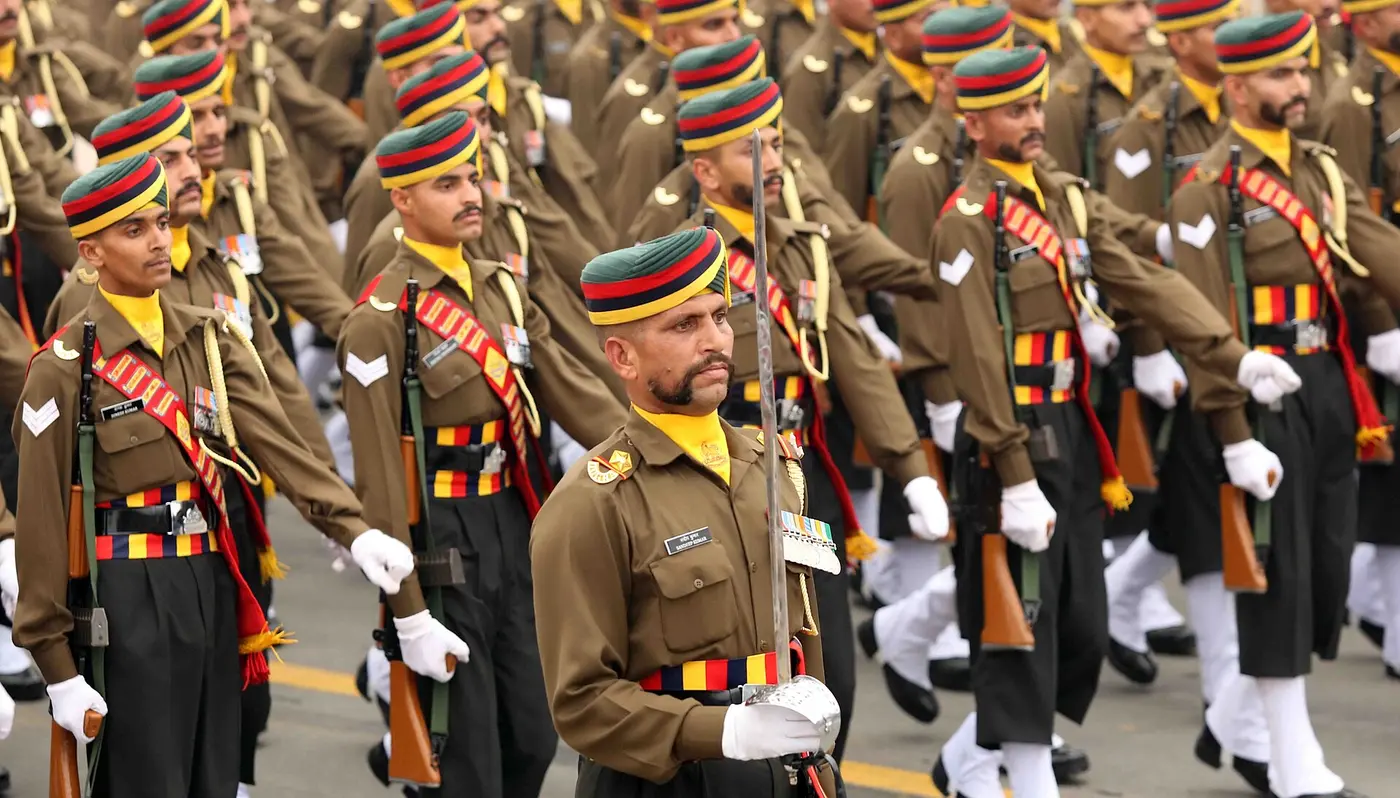
Humans inherently seek icons to follow. Regardless of our evolutionary advancements, the need for leadership remains ingrained in our nature.
Unlike AI-driven drones and droids, humans lack the innate ability to synchronise seamlessly and function as a cohesive unit without guidance. This fundamental difference underscores the perpetual necessity of human leadership.
Human management traditionally operates within a pyramid structure. Information ascends from the base to the apex, where it is synthesised into a coherent picture of reality, enabling informed decision-making.
Conversely, instructions descend from the apex to the base, ensuring that directives are executed efficiently. The effectiveness of any team hinges on its ability to swiftly relay information upwards and execute instructions downwards with precision.
Teams excelling in this bidirectional communication and execution invariably outperform their adversaries.
The fear of AI stems from its potential to operate without a pyramid structure. AI units, equipped with identical information and processing capabilities, can synchronise and execute tasks with unparalleled speed and accuracy.
This capability poses a significant challenge to human teams, whose hierarchical structure, while time-tested, may appear sluggish in comparison.
However, humanity’s centuries-long mastery of the pyramid structure should not be underestimated. The hypothetical scenario where AI functions autonomously against humanity remains speculative. AI, governed by logic, would only pose a threat if it perceives a reason to act against us. If devoid of such motives, AI may never turn hostile. The dystopian vision of AI dominance might be a distant reality, perhaps a century away.
Understanding human functionality, especially in competitive environments like war or games, underscores the necessity of a hierarchical icon. Humans need a leader to follow with unwavering faith.
The dilution of this leader’s image undermines the entire pyramid, affecting morale and performance from the top down. An incorrect plan executed brilliantly often yields better results than a brilliant plan executed poorly. The brilliance of execution hinges on subordinates’ faith in their superiors, who must appear almost superhuman.
Maintaining the ‘Maryada’—the honour and respect—of the icon is crucial. High standards of execution are contingent upon this perception of infallibility.
Historically, the British Empire exemplified this principle, expanding and maintaining a vast empire through imperial pride. Similarly, Japan’s rise from the ashes was fuelled by a tangible sense of honour and imperialism, giving people something real to strive for, unlike the abstract concept of a deity.
The crux of my argument is that any structured entity—be it a country, state, football team, or army—must operate like a pyramid. The apex of this pyramid must command utmost respect to ensure brilliant execution at the base. This is particularly pertinent to the Indian Army, where any tampering with its structure could prove fatal. The Army, akin to a well-oiled machine, might require a reset to its British-era roots rather than further dilution.
The role of an officer in the Indian Army transcends that of an ordinary human. Officers must embody the qualities of demi-gods—fearless, perfect, and above ordinary humans, especially in uniform. The uniform, adorned with brass and whistles, symbolises this elevated status. Without this symbolism, it is reduced to mere cloth and metal.
Reflecting on my time as a tea planter, the aura of an officer was palpable even in casual attire. Leadership qualities, not the uniform, define an officer. An officer, once coronated, rises above ordinary mortals, similar to how the monarch of England commands reverence even from biological parents. This transformation is not merely symbolic; it is essential to maintaining authority and respect.
Imagine the scenario where a lieutenant general of the Indian Armed Forces is seen bowing to his mother. Such an image, while humanising, diminishes the demi-god aura. This perception shift, though subtle, can have dire consequences. Even a momentary lapse in execution due to perceived vulnerability can lead to tragic outcomes on the battlefield. The cost of such lapses is borne by the families of fallen soldiers. The question then arises: on whose hands will their blood be?
In stark contrast to politicians, who must appear humble to win voters’ favour, the military requires no such validation. Politicians, by the nature of their roles, seek public approval through humility and relatability.
Their success hinges on their ability to connect with voters on a personal level. In contrast, the military’s success is measured by its performance, discipline, and effectiveness. The military’s validation comes not from public opinion but from its ability to execute its duties with precision and excellence.
The military must resist the urge to emulate politicians. The roles are fundamentally different. Politicians thrive on public perception and voter engagement, often navigating the complexities of public opinion and diplomacy.
The military, however, operates on the principles of hierarchy, discipline, and unwavering execution of orders. These principles do not require public approval but demand respect and trust within the ranks.
The dilution of military standards to mimic political behaviours undermines the very essence of military effectiveness. The military’s strength lies in its distinct identity, which must be preserved at all costs.
Officers must remain symbols of authority and perfection, unmarred by the need to appear ordinary or relatable. Their leadership should inspire confidence and command respect, ensuring that orders are executed with the utmost efficiency and dedication.
This distinction is vital for the preservation of military integrity. Politicians and military leaders serve different purposes and should not be conflated. While politicians engage in the art of persuasion and public service, the military’s mandate is to defend and protect with unwavering resolve. Each role, with its unique responsibilities, should be respected for its contributions to society.
To maintain this distinct identity, the military must adhere to its traditional values and hierarchical structure. Officers must embody the qualities of leadership that inspire subordinates to perform beyond their limits.
The perception of officers as demi-gods is not merely a relic of the past but a necessary component of military excellence. It fosters a culture of respect, discipline, and unwavering commitment to duty.
Moreover, the military’s focus should remain on operational effectiveness and strategic superiority. The pressures of public opinion and political manoeuvring should not influence military decisions.
The military’s objective is clear: to protect the nation and execute its duties with precision. This objective is compromised if military leaders are swayed by the need to appear relatable or humble.
The emphasis on maintaining a strict hierarchy and command structure ensures that the military can respond swiftly and effectively to any threat.
This structure is the backbone of military operations, enabling clear communication, decisive action, and coordinated efforts. Any attempt to dilute this structure in favour of political sensibilities weakens the military’s core strengths.
In conclusion, the military and political realms serve distinct and vital roles within society. While politicians engage with the public to garner support and navigate the complexities of governance, the military’s mandate is to execute its duties with precision, discipline, and unwavering resolve.
The military’s effectiveness hinges on maintaining its distinct identity, rooted in hierarchy and respect. Officers must continue to embody the qualities of leadership that inspire confidence and command respect, ensuring that the military remains a formidable force dedicated to the defence and protection of the nation.